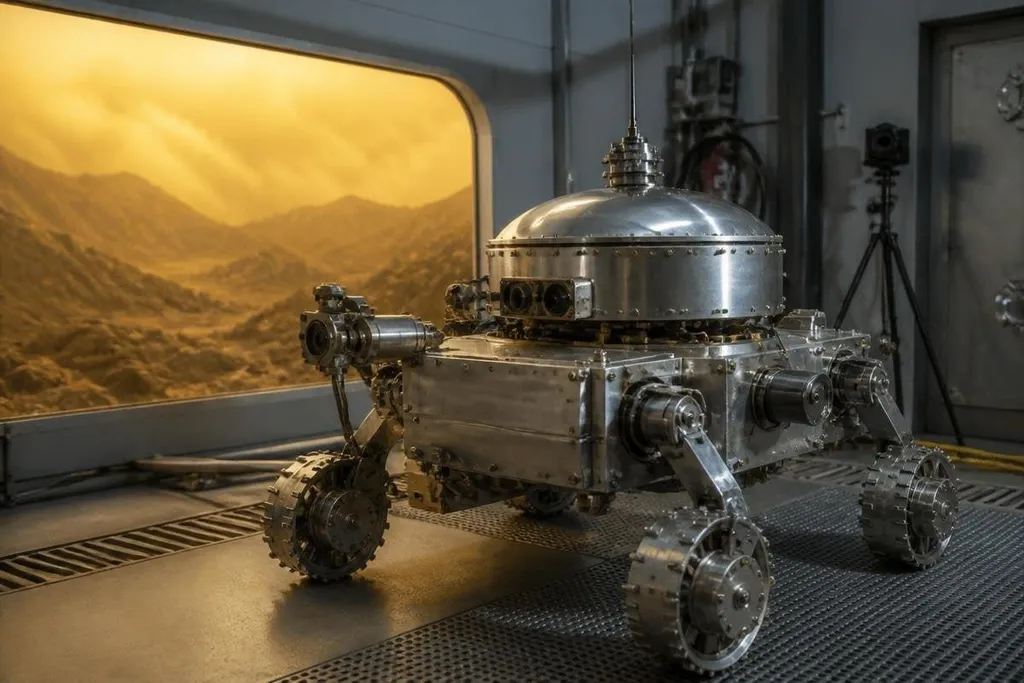
Venus is hot enough to melt lead, with a surface temperature near 465 °C and air pressure about 92 times higher than at sea level on Earth. Any robot sent there would need to keep working after landing, not only reach the planet.
This makes Venus a hardware problem before it becomes a science problem. The machine must sense rock, move through dust, send data through thick air, and protect its electronics without relying on a large cooling system.
- Heat sets the clock: ordinary spacecraft electronics stop working quickly at Venus temperatures.
- Pressure shapes the body: the robot needs a sealed shell and strong joints.
- Short visits still count: Soviet Venera landers returned data from the ground before failing.
What makes Venus so hard
The heat comes from the planet's thick carbon dioxide atmosphere, which traps energy near the ground. The pressure adds another problem: a robot's outer shell must resist forces that would crush many Earth-built systems.
Cooling the inside with a normal fan or liquid loop would take power and add parts that can fail. A better design may keep the electronics in a pressure vessel, with only sensors, motors, and tools exposed to the outside air.
The Soviet Venera program showed that landing was possible. Venera 13 reached the ground in 1982 and worked for about 127 minutes, returning color images and soil data before the heat and pressure stopped it.
That short operating time still changed what scientists knew about Venus. A modern lander that worked for several hours could study more rocks, test more locations, and send back a larger set of measurements.
How a Venus robot could stay alive
One design path uses high-temperature electronics made with materials such as silicon carbide. These parts can work at temperatures that would damage standard silicon chips, although a full computer, memory system, and radio still need careful testing together.
Another path stores normal electronics inside a cooled pressure vessel. The vessel could use insulation and phase-change material, which absorbs heat as it changes state. The trade is simple: more stored cooling material means more operating time, but also more mass to land on Venus.
A third option splits the robot into two parts. Hot tools and sensors would work outside, while a protected electronics box would handle computing and radio tasks. Cables, seals, and motor shafts would then become weak points, so engineers would need to test those parts at Venus temperatures and pressure.
The robot would also need a way to move. Wheels may work on flat ground, but Venus has rocks, slopes, and loose soil. A short-legged vehicle could place its feet with care, while a stationary lander could avoid the motor problem and focus on drilling, imaging, and sampling.
What the robot should do first
A first mission should keep its task list short. Every extra motor, tool, and moving joint adds another part that must survive the heat.
The most useful early jobs would include measuring soil chemistry, mapping nearby rocks, checking wind at ground level, and recording how materials change during the stay. A small drill could also compare material below the surface with material exposed to the air.
Those measurements depend on a robot that can keep working after Earth sends its next command too late. A dated Robot 24 report on Venus robots can place the control system, sensor tasks, and mission limits beside the data the machine must gather.
The robot would need local control because communication with Earth takes too long for hand-by-hand driving. Its computer would choose safe movements from sensor readings, while Earth teams sent goals and reviewed the data later.
What remains unproven
The main gap is endurance. Venera 13 proved that a lander can work for a little over two hours, but that result came from a Soviet design built for a short visit.
It doesn't show that a mobile robot can drive, drill, process samples, and transmit data for days.
High-temperature chips also need a full system around them. A computer may tolerate the heat while a connector, battery, camera, or motor fails first. Testing each part alone won't prove that the complete robot can operate on the ground.
I'd favor a simple Venus lander before a walking robot. A fixed platform can return useful measurements with fewer motors and seals, giving engineers a better test of electronics and cooling before they add mobility.
A practical design check
Before approving a Venus robot, a mission team should ask:
- Heat budget: how many hours can the electronics work at about 465 °C?
- Pressure shell: what pressure has the sealed vessel passed in testing?
- Moving parts: which motors, bearings, and seals face the outside air?
- Power plan: how much energy goes to cooling, computing, movement, and radio?
- Fallback task: what data can the robot return if its drill or drive system fails?
- Proof test: has the full machine run together under Venus-like heat and pressure?
The next useful Venus robot may look less like a rover and more like a pressure vessel with a few tools. If its electronics can work for hours instead of minutes, engineers can then ask the harder question: how far should the machine travel before the heat wins?